


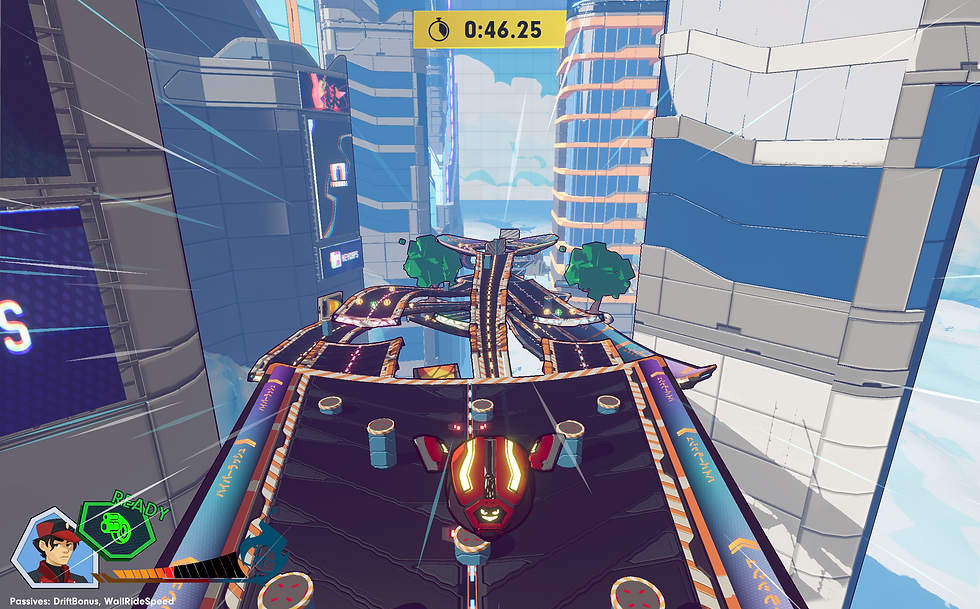
Hyper Rush is an asynchronous multiplayer platformer-racer with an emphasis on high-octane, mastery-driven speedrunning gameplay. Select your character and Orball, then launch onto the track as you Drift, Dive, Wall-Jump and Rush your way through obstacles to reach the goal. Optimise your racing through strategic use of your character's abilities, and set the best times possible across each of the game's unique multi-route tracks!
Our team was only small when I joined early in development in February 2021, but over time grew to a large 40+ multi-disciplinary team. I took on primary responsibilities of the game's level design, as well as the overall game design, and collaborated extensively cross-discipline to design content of the highest quality. The game's vision shifted radically throughout development and through these experiences I grew significantly as a designer, even having the privilege of mentoring Junior Designers and Graduates in Level Design.
Developer: Mighty Kingdom
Platform: PC/Console
Genre: Platformer-Racer
Years Developed: 2021-2022
Roles:
-
Game Designer
-
Level Designer
Software Used:
-
Unity
-
Fork/Github
-
Jira
-
Miro
-
SyncSketch
-
Sharepoint
-
Adobe Photoshop
-
OBS Studio
Please note the content on this page showcases the state of the project as it was shown to the public at Gamescom 2022. This work is not final and may change before release.
Development of Processes and Tools
Being on the project from its early stages, I had the opportunity to develop and iterate upon design processes to create consistent in our track design using tools such as Miro and SyncSketch. These were used to get buy-in from the team, and eventually to on-board other designers onto the level design of the game. I upkept all the documentation around these processes, ensuring we always had an up-to-date source of truth on best design practices.
I also worked closely with Engineering and Tech Art to design the various tools we used to develop the game's track and obstacles. This was an iterative process with significant cross-discipline communication, which ultimately was successful and allowed the design team to rapidly iterate on designs to find what best worked for our game.


Taking ownership of track and obstacle design
Over the course of development I established and iterated upon various processes we used to develop the tracks and their obstacles. Using Unity, I rapidly iterated several prototype tracks to establish our design heuristics and figure out what obstacles would best serve our multi-route gameplay. After this I developed the game's full-scale tracks, using player feedback from internal and external playtests to help guide my design decisions and bring them up to a professional standard.


Mentoring Junior Designers
As one of two designers who started on the project, when the design team grew I took responsibility for on-boarding new designers onto the level design process. This included teaching them how each of our in-engine tools worked, as well as mentoring them in our design practices and how we planned out the game's content and tracks. I'm incredibly proud to have had the opportunity to pass on my knowledge to them, and was always excited to see them grow and use their experiences to improve our project.